


Photo by Jonathan Borba
There's no single best breast pump, only the one that fits your body, your baby and the way your days actually run. If you've stood in a shop aisle or scrolled through endless reviews feeling more confused than when you started, you're not alone. Most of us buy our first pump before we know how feeding will go, and that's a hard decision to get right in advance.
So let's make it simpler. Here's what's worth knowing before you spend any money, and how to match a pump to your real life rather than to a list of features.
First, Picture How You'll Actually Use it
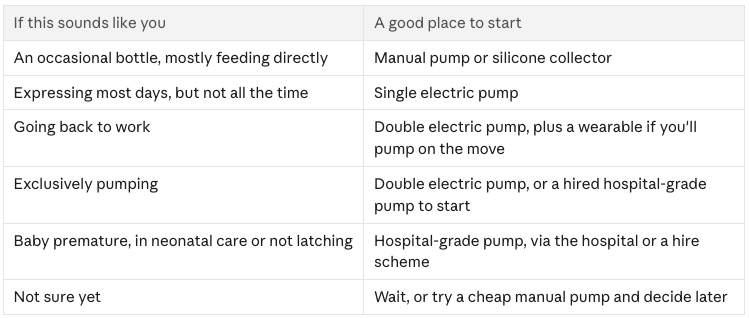
Before you look at a single pump, ask yourself how often you'll actually use it. That one answer narrows things down more than any spec sheet. Most mums fall into one of these:
Now and then. You're mostly feeding directly but want the odd bottle so someone else can do a night feed, or so you can have an evening out.
Back to work. You'll be expressing once to three times a day, often somewhere that isn't your home, on a schedule that isn't yours.
Exclusively pumping. Your baby feeds from a bottle of your milk, so the pump is doing the job a baby would normally do, eight or more times a day.
Building or protecting supply. Your baby is premature, in neonatal care, struggling to latch, or you've been advised to express to bring your milk in.
It's also completely fine if you don't know yet. Plenty of mums wait until a few weeks in to see how feeding settles before buying anything. A pump bought in pregnancy based on guesswork is often the one that ends up in a drawer.
The Main Types of Pumps
Silicone collectors. A soft, one-piece cup that suctions onto one breast and catches milk while you feed from the other. No motor, no noise, very cheap. Lovely for saving let-down milk in the early weeks, but it isn't a true pump and won't keep up with regular expressing.
Examples: the Haakaa Silicone Breast Pump is the one most mums have heard of. The Elvie Curve is a similar option with a hands-free design.
Manual pumps. You squeeze a handle to create suction. They're quiet, light and affordable, and you control the rhythm completely. Brilliant for occasional use or as a backup in your bag, but tiring on your hand if you're expressing every day.
Examples: the Medela Harmony Flex and the Philips Avent manual pump are both long-standing favourites.
Single electric pumps. A motor does the work on one breast at a time. A good step up if you'll express most days but not constantly.
Example: the Medela Solo, the updated version of Medela's popular Swing.
Double electric pumps. Both breasts at once, which roughly halves your pumping time. Expressing from both sides together can also help with let-down and supply. Usually the best fit for returning to work or exclusive pumping.
Examples: the Spectra S1 (a cult favourite with exclusive pumpers), the Lansinoh 2-in-1 Double Electric and the Medela Swing Maxi.
Wearable pumps. The motor and collection cups sit inside your bra, with no tubes or wires. You can pump while walking around, doing the school run or sitting in a meeting. The trade-off: they often hold less milk, can be less efficient than a traditional double pump, and cost more. Many mums use one alongside a standard pump rather than instead of it.
Examples: Momcozy has several popular models, including the M5 and V2, and is easy on the budget. The Elvie Pump sits completely inside your bra, and so does the MAM Move. The Elvie Stride and Medela Freestyle Hands-free use in-bra cups with a small clip-on motor, so they're more powerful but not quite tube-free.
Hospital-grade pumps. Heavy-duty double pumps built for very frequent use. They're expensive to buy, so most people hire one. They're often recommended if your baby is premature, unwell, can't feed directly, or if you're establishing supply by pumping alone.
Examples: the Medela Symphony is the one you'll most often see on hospital wards. Ardo hires out the Ameda and Carum hospital-grade pumps.
The Features That Matter
Flange fit comes first. The flange (or breast shield) is the funnel that sits over your nipple, and getting its size right matters more than almost any other feature. Too small and it pinches and rubs; too large and it pulls in too much tissue. Either way, pumping can hurt, and less milk comes out. Before you buy, measure your nipples (a midwife, health visitor or lactation consultant can help) and check the brand offers your size, either in the box or as a spare. It's worth measuring again after a few weeks, as nipples often change size once feeding settles.
Adjustable suction and modes. Look for a pump that lets you control strength and speed, ideally with a gentle, faster "let-down" phase before a slower expressing phase. Stronger isn't better. Pumping should feel like a firm tug, never pain.
Warmth and massage settings. Some newer pumps, such as the eufy S1 Pro, have gentle heat or massage built in. They're not essential, but if you find it hard to relax while pumping, they can help your milk start flowing.
Open or closed system. In a closed system, a barrier stops milk from reaching the motor and tubing. It's more hygienic and the only kind that can safely be passed on or hired out.
Noise. If you'll pump at work, at night beside a sleeping baby, or with a partner on the sofa, a quieter motor makes a real difference.
Power and portability. Rechargeable batteries free you from hunting for a plug. Think about weight and size if it's coming to work with you every day.
Cleaning. Count the parts. You'll be washing them several times a day, sometimes at 3 am. Fewer, simpler parts make life easier.
Spare parts. Valves and membranes wear out. Make sure replacements and extra bottles are easy to find and affordable before you commit to a brand.
Cost, Hiring and Buying Second-Hand
You don't need the most expensive pump to have a good experience. Spend on what matches your situation, not on features you'll never use.
Ask before you buy. If your baby is in neonatal care or you've been advised to express, ask your midwife, neonatal nurse or hospital infant-feeding team whether a pump can be loaned locally. Some areas run loan schemes.
Hiring. Hospital-grade pumps can be hired privately and delivered to your home. As one example, Medela's Symphony rental is listed from around £49 for the first 14 days, and Ardo also hires out hospital-grade pumps. You'll usually need to buy your own collection kit, since that part touches your milk. Hiring is a smart way to find out whether you'll pump long-term before buying anything.
Second-hand. Only consider a closed-system pump, and always fit brand-new tubing, flanges, valves and bottles. Open-system pumps can hold milk residue in the motor that can't be cleaned out, so they're meant for one person only. If you're unsure which kind you're looking at, it's safest to skip it.
Quick Guide: Which Pump Fits You?
Be Kind to Yourself Along the Way
The first few sessions with any pump can feel awkward, and the amount you express isn't a measure of how much milk you make. Babies are far better at removing milk than any machine.
What often makes the biggest difference is your let-down, the reflex that releases your milk. It's driven by oxytocin, the same hormone behind that warm, calm feeling, and stress or distraction can hold it back. So it's worth setting yourself up to relax. A warm flannel on your breasts first, a gentle massage before and during pumping, a photo or video of your baby, or even a sock over the bottle so you're not watching every drop can all help.
If pumping hurts, if your supply worries you, or if it simply isn't working, reach out. Your midwife, health professional, an infant-feeding specialist or a breastfeeding helpline can help you troubleshoot fit, settings and routine. Watch for signs of mastitis, too: a red, hot, or increasingly painful patch on your breast, flu-like symptoms, or simply feeling unwell. If you notice any of these, contact your doctor promptly rather than waiting for it to pass. For what to do in the meantime, our Mastitis S.O.S. Guide walks you through it.
And if you decide pumping isn't for you, that's a valid choice too. The right pump is the one that makes your life a bit easier. If none of them do, that's okay!
P.S. If it all feels like too much, tell your doctor or a health professional. You don't have to manage it alone.
Packing your hospital bag?
Whatever you decide about pumping, the first weeks after birth are easier with the right things to hand. The Coco Birth Box brings together the postpartum recovery essentials, from breast pads and maternity pads to soothing care for your healing body. It's one less thing to think about.

The box that sees you, too.
There's so much preparation for bringing a baby into the world. But what about the mum who's bringing them here?
Coco Birth Box is a practical postpartum recovery kit, created by a mum who's been through it and knows that recovering from childbirth involves a lot more than anyone really talks about.
Forget the candles and herbal teas. We're talking maternity pads, disposable pants, cooling pads and all the less glamorous bits of postpartum that actually come in handy.
Whether you're preparing for your own recovery or buying for a mum-to-be, we've brought together the essentials to save you the research, shopping around and last-minute panic.
What's inside?
Disposable maternity underwear
Maternity pads
Washable breast pads
Spritz for Bits spray
Compact peri bottle attachment
Cooling pads
Wipes & ointment (including Anusol)
Bio-Oil
Recovery & product-use guide
One item contains a nut-based ingredient.
Small-batch, thoughtfully packed and ready for the fourth trimester.